

A well-made cotton tee should last years. Most do not, and the reason usually has nothing to do with how it was made. It has to do with what happened to it every week or so in a machine.
Cotton is a durable fiber, but it has specific vulnerabilities, and standard laundry habits target almost all of them at once. Fixing that does not require anything elaborate. It requires understanding what actually damages the garment.
What heat does to cotton
Heat is the single largest factor, and it matters in two separate places.
Cotton fibers are spun into yarn under tension, and that yarn is knitted into fabric under tension too. Heat and agitation together relax that tension, and the fabric contracts. That is shrinkage. It is not the fiber getting smaller; it is the structure pulling back toward the state it would rather be in.
Most of this happens the first time a garment meets high heat, which is why a shirt that survived one hot wash intact may be noticeably shorter after the second. Pre-shrunk fabric has been through a controlled version of this at the mill, which reduces how much is left to give up, but it does not eliminate it.
The practical instruction is straightforward:
- Wash cold. Cold water cleans normal body soil and sweat perfectly well with modern detergent. Hot water is for sanitizing and for heavy grease, neither of which describes a T-shirt.
- Skip the dryer, or use low heat. The dryer combines the two things cotton likes least: sustained heat and constant mechanical agitation. It is harder on a garment than washing is.
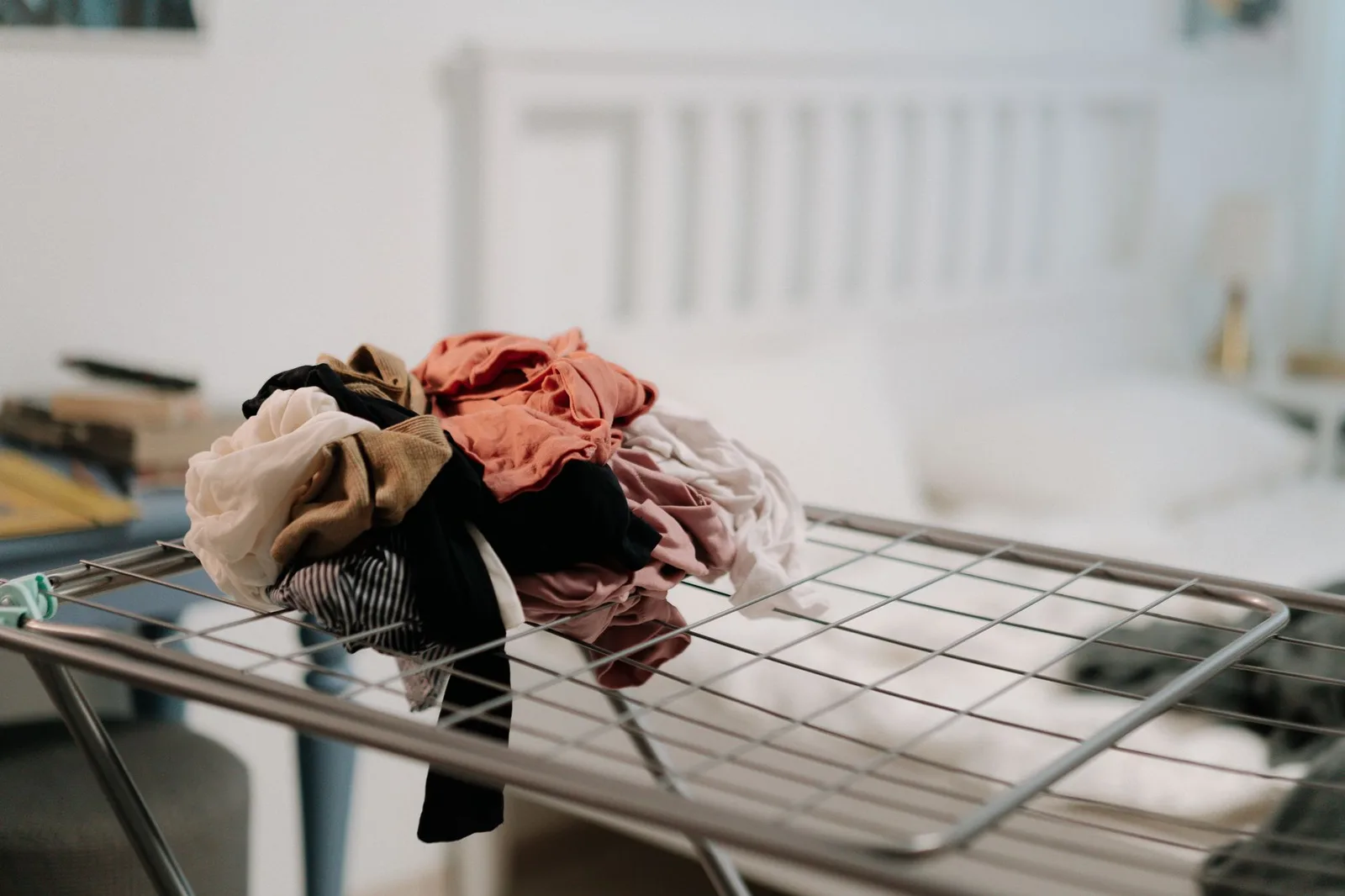
If the dryer is not negotiable in your household, pull garments out while they are still slightly damp and let them finish on a hanger or a rack. Most of the damage happens in the last stretch of the cycle, when the fabric is dry and the machine keeps tumbling and heating it.
The lint trap is a damage report
Worth noticing at least once: dryer lint is your clothing. Those fibers were part of a garment before the cycle started. A full lint screen after a load of towels is unremarkable. A full lint screen after a load of T-shirts means the fabric is being abraded, and fabric that is being abraded is thinning.
This is the clearest available evidence that tumble drying is a subtractive process. It is not a claim about how much life it costs, because that depends on the machine, the load, and the fabric, but the direction is not in question.
Turn things inside out, especially anything printed
Printed graphics take the worst of a wash cycle. Screen-printed ink sits on top of the fabric, and direct-to-garment printing bonds into the surface fibers, but both are exposed to whatever else is in the drum.
Turning a shirt inside out means the print rubs against the inside of the same shirt instead of against zippers, buttons, denim rivets, and the drum wall. This single habit does more for the lifespan of a graphic tee than any specialized detergent.
Two related points if you own printed pieces:
- Never iron directly onto a print. Heat softens the ink film and an iron will lift or gloss it. Iron inside out, or work around the print.
- Wash printed items with other soft items where you can. A load of graphic tees and a load of jeans with metal hardware are two different loads.
The same logic applies to our graphic tees, where the print is the reason you bought the shirt and also the first thing that shows wear.
Detergent: less than you think
Overdosing detergent is extremely common and quietly counterproductive. Excess surfactant does not rinse out completely. It stays in the fabric, attracts soil, and leaves cotton feeling stiff and looking dull. People then interpret that dullness as the garment wearing out, and often respond by adding more detergent.
Use the amount indicated for your load size and water hardness, and if your clothes feel stiff or slightly waxy, run a rinse-only cycle with nothing added and see whether they improve.
Two additives worth thinking about:
Fabric softener works by coating fibers with a lubricating film. On cotton this reduces absorbency, which is why it is a poor idea on towels, and it can gradually dull colors. It is not catastrophic, but it is doing less for you than the marketing implies.
Oxygen-based brighteners are generally fine on white cotton and useful for restoring whites that have gone grey. Chlorine bleach is more aggressive and will weaken cotton fibers with repeated use.
Hanging, folding, and the neckline problem
A stretched-out neckline is usually a storage problem rather than a wash problem.
Hanging a knit garment lets gravity work on it continuously. The weight of the body of the shirt pulls down on the shoulders and collar for however long it hangs. Over months, that shows. Knits should be folded. Wovens — button-up shirts, jackets — hang perfectly well because the fabric does not stretch the same way.
If you are attached to hanging your tees, fold them over the bar rather than putting them on a hanger by the shoulders.
Two more handling notes that add up:
- Take a tee off by pulling from the hem upward rather than dragging it over your head by the collar. The collar is the part you cannot repair.
- Let a garment dry completely before folding it into a drawer. Cotton stored damp is where mildew starts, and the smell does not fully wash out.
A short version you can actually follow
- Wash cold, inside out, on a normal cycle.
- Use the recommended amount of detergent, not more.
- Air dry when you can; low heat and early removal when you cannot.
- Fold knits, hang wovens.
- Keep printed items away from hardware and away from irons.
That is the entire routine. There is no specialized product involved, and none of it takes extra time once it is habit.
Treat stains before they set, not after
Most stains are far easier to remove in the first hour than on laundry day, and a stain that has been through a warm dryer is often permanent — heat sets many of them into the fiber.
A few principles that cover most situations:
- Blot, do not rub. Rubbing pushes the stain deeper into the yarn and abrades the surface.
- Cold water first. Hot water sets protein stains, which covers a surprising amount of what ends up on clothing.
- Work from the outside in, so the stain does not spread outward into clean fabric.
- Do not dry it until the stain is gone. If it survives the wash, wash it again. Once it goes through heat, your options narrow considerably.
Oily stains are the exception to the cold-water rule and generally need a detergent applied directly to break up the oil before washing.
Knitwear has its own set of rules, particularly around drying and off-season storage, which is covered separately.
How often is often enough
There is no rule that a garment must be washed after a single wear, and washing is where nearly all the wear happens.
A tee worn against the skin for a full day generally needs washing. A hoodie worn over a tee for a few hours does not. Airing something out overnight handles a surprising amount of light odor, and knitwear in particular benefits from being worn several times between washes.
This is not an argument for wearing dirty clothes. It is a recognition that each cycle costs the garment something, so the cycles should be worth it. Halving how often a hoodie goes through the machine roughly doubles the number of wears it gets before it looks tired.
When care is not the problem
Sometimes a garment fails because of how it was built, and no laundry routine fixes that. A neckline with no shoulder tape will lose its shape regardless. A single-stitched hem will unravel eventually. Thin, loosely spun yarn will pill at the underarms whatever you do.
That is worth knowing before you buy rather than after, and it is the reason construction details are worth reading alongside the fiber content. Care extends the life of a well-made garment. It cannot add durability that was never built in.
If something arrives from us and does not hold up the way it should, that is what our returns process is for. A garment failing early is information we want.