

Fiber content is the one part of a garment label that is regulated, reliable, and genuinely predictive. It is also the part most people read without knowing what it implies.
Here is what each of the common options actually does, including the tradeoffs that do not show up until the garment has been washed twenty times.
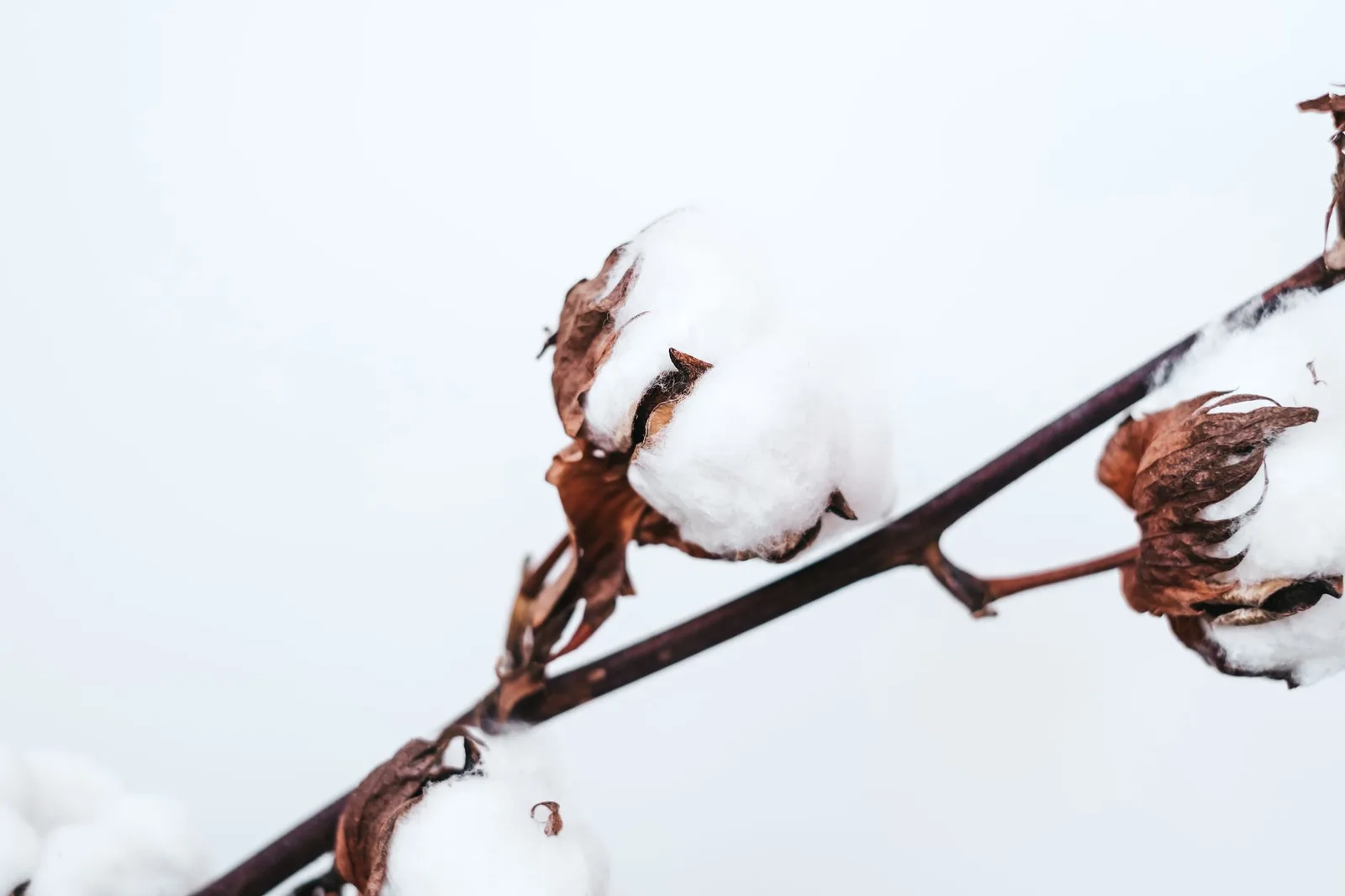
Cotton
A natural cellulose fiber, and the default for casual clothing for good reasons.
Strengths. Breathable and comfortable against skin. Absorbent, so it handles sweat without feeling clammy immediately. Takes dye well. Softens with wear rather than degrading. Handles heat well enough to be washed at temperature when necessary.
Weaknesses. Absorbency cuts both ways — cotton holds moisture and is slow to release it, which is why a cotton shirt stays wet and gets cold after exertion. It wrinkles. It shrinks with heat. It is weaker when wet than when dry, so a heavy wet cotton garment stretches under its own weight if you hang it.
Where the quality varies. Enormously. Fiber staple length is the main variable: longer fibers produce smoother, stronger, less pill-prone yarn. Combed and ring-spun cotton are both processing steps that improve the yarn, and both are worth having when they are mentioned.
Polyester
A synthetic fiber, essentially a fine plastic filament.
Strengths. Strong and abrasion resistant. Holds its shape and resists wrinkling. Hydrophobic, so it does not absorb water — it moves moisture along the surface and dries quickly, which is why athletic clothing is dominated by it. Colorfast. Cheap.
Weaknesses. Low breathability compared to cotton. It holds odor stubbornly, because the compounds that cause it bind to the fiber and do not rinse out easily. It can feel slick or plasticky at low quality. And it is heat-sensitive in a way cotton is not — a hot iron will melt it rather than scorch it.
Pilling. Polyester's strength works against it here. When a fiber end works loose and tangles into a pill, a cotton pill eventually breaks off. A polyester pill is strong enough to stay attached, which is why synthetic-heavy fabrics accumulate pills at the underarms and wherever a bag strap sits.
The common blends
50/50 cotton-polyester. The classic workhorse. Less shrinkage than cotton, more breathability than polyester, wrinkles less, dries faster. It is a genuine compromise rather than a best-of-both — it breathes worse than cotton and dries slower than polyester.
60/40 and 65/35. Variations on the same theme, weighted toward whichever property mattered more.
Tri-blends (typically cotton, polyester, rayon). Very soft with a fluid drape and a slightly heathered look. The rayon is what produces the softness and the drape. They tend to be lighter, more transparent, and less durable than a solid cotton fabric of similar weight. Good for a garment whose job is to feel nice and drape well; poor for one that needs to hold structure.
Cotton with 5% elastane. Stretch and, more importantly, recovery — the ability to return to shape rather than bagging out at the knees and elbows. The elastane is the first component to fail, and heat accelerates that, so these garments should stay out of the dryer if you want the stretch to last.
Rayon, viscose, modal, lyocell
These are worth grouping because they are all regenerated cellulose — plant material chemically processed into fiber. They are neither natural in the way cotton is nor synthetic in the way polyester is.
Shared characteristics. Excellent drape, smooth hand, good absorbency, takes dye brilliantly. Considerably weaker when wet than when dry, which is the practical thing to know: they need gentle handling in the wash and should be dried flat rather than hung.
Lyocell (often sold under the Tencel brand) is produced in a closed-loop process that recovers most of its solvent, which makes it the most environmentally favorable of the group. It is also stronger when wet than conventional viscose.
Modal is notably soft and more dimensionally stable than standard viscose, which is why it turns up in underwear and loungewear.
Wool, and why it behaves unlike anything else
Wool deserves separating out, because it does things no other common fiber does.
Each wool fiber has a crimped structure and a scaled surface. The crimp traps air, which is where the insulation comes from. The scales are what allow felting — under heat, moisture and agitation the scales interlock permanently, which is why a wool sweater that goes through a hot wash comes out child-sized and stays that way. Felting is not shrinkage. It cannot be reversed.
The genuinely unusual property is that wool insulates while damp. Most fibers stop working when wet; wool continues to hold warmth, which is why it persists in outdoor clothing despite synthetics being cheaper and lighter.
Merino is wool from a breed with a finer fiber diameter. Fineness is what determines itch — coarse wool fibers are stiff enough to prickle the skin, fine ones bend instead. Merino also resists odor well, which is why it is common in base layers meant to be worn for days.
The tradeoffs are cost, slower drying than synthetics, and vulnerability to moths in storage. Wool is also weaker than cotton in raw tensile terms, so a loose knit will show wear at the elbows.
Choosing by use, not by preference
The right fiber depends on the garment's job.
A tee worn on its own in warm weather: cotton, midweight. Breathability and comfort are the whole point, and the moisture problem only matters if you are working hard.
A base layer under other clothing: synthetic or merino wool. This is exactly the case where cotton's absorbency becomes a liability, as any layering system depends on the base layer moving moisture.
A hoodie for general wear: cotton or a cotton-heavy blend. Warmth comes from the fleece structure more than the fiber.
Anything that needs to hold a crisp shape: a blend. Pure cotton wrinkles, and there is no way around that.
Anything that needs to drape: rayon, modal, or a tri-blend. Fiber is one of the two levers on drape; the other is how the fabric is finished and cut.
Care follows fiber
Each fiber fails differently, so the care instructions are not interchangeable.
- Cotton: cold wash, low or no heat drying. Heat is the enemy, and it is the cause of nearly all shrinkage.
- Polyester: cold wash, low heat. High heat can distort the fiber permanently. Wash promptly, since odor sets in.
- Elastane blends: no heat at all if you can manage it. Heat is what kills the stretch.
- Rayon family: gentle cycle or hand wash, dry flat. Wet strength is genuinely low.
- Wool: cool water, no agitation, dry flat. Agitation plus heat is what felts wool, and felting is irreversible.
Nearly all of that reduces to "less heat, less agitation," which is the entire foundation of getting laundry right.
A note on what "better" means
There is no best fiber, and treating natural as automatically superior to synthetic does not survive contact with the details. Polyester is the correct answer for a running shirt and the wrong answer for a summer tee. Cotton is comfortable and genuinely poor at moisture management. Rayon drapes beautifully and tears when wet.
Our tees are cotton because they are made to be worn as outerwear in mild weather, where breathability and hand feel matter more than dry time. That is a decision about use. A different garment with a different job would justify a different answer.