


Warmth in clothing is not a property of fabric. It is a property of air.
Still air is a poor conductor of heat, which makes it excellent insulation. Every warm garment works the same way: it holds a layer of air near your body and stops that air from being carried off. Down does it, wool does it, and fleece does it.
Once you know that, several things about hoodies stop being mysterious.
Loft is the mechanism
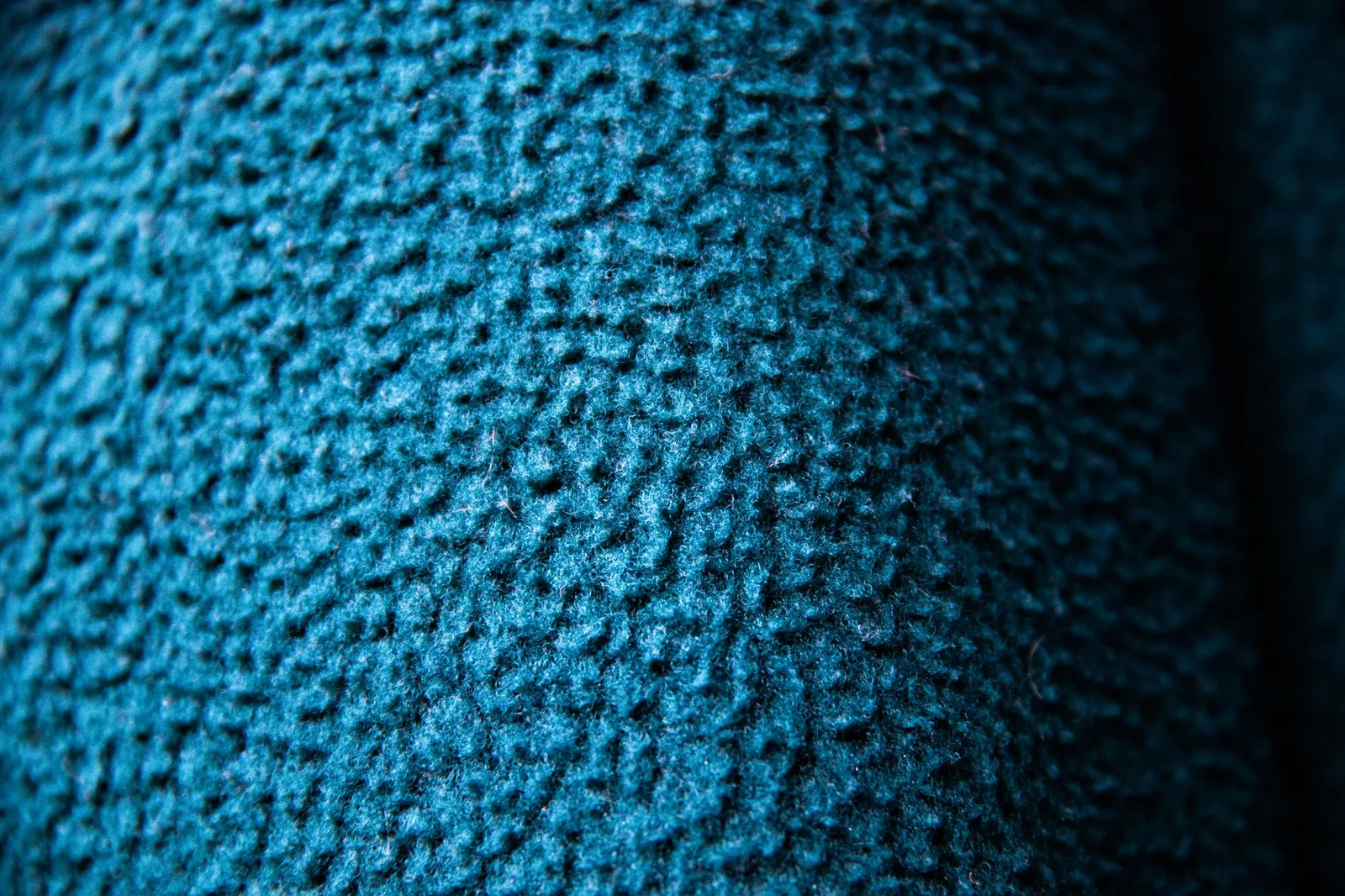
The inside of a sweatshirt is where the work happens. Fleece is knitted with an extra yarn on the interior surface, which is then brushed to raise the fibers. Those raised fibers create a three-dimensional structure full of small air pockets.
More loft means more trapped air means more warmth. This is why a light, lofty fleece can be warmer than a heavier, denser fabric — the heavier one may simply have more material and less air.
It also explains something people find counterintuitive: compressing a fleece makes it colder. Squash the loft flat under a tight jacket and you have squeezed the air out of the insulation. The fabric is still there and it is no longer doing its job.
French terry versus brushed fleece
The two constructions you will actually encounter.
French terry has loops on the interior rather than a brushed surface. Those loops trap some air but far less than raised fibers do. It is lighter, more breathable, faster to dry, and noticeably less warm. Good for mild weather and for anyone who overheats easily.
Brushed fleece takes that same loop structure and brushes it open into a soft, lofted surface. Warmer, heavier, slower to dry, and softer against the skin. This is what most people picture when they think of a sweatshirt.
Neither is better. They are for different temperatures. A brushed fleece hoodie in 60°F weather is uncomfortable in exactly the way a french terry one is at 40°F.
Where the fabric weight number misleads
A hoodie listed at 400gsm sounds warmer than one at 320gsm, and it might not be.
Weight tells you how much material is present per square meter. It does not tell you how that material is arranged, and arrangement is what determines loft. A dense, tightly knitted 400gsm fabric with a flat interior can trap less air than a lofted 320gsm fleece.
Weight does correlate with warmth in a rough way, because heavier fleece usually does have more loft. But it is a proxy, not a measurement, and it is worth understanding what the number is actually reporting before paying a premium for it.
The details that matter more than people expect
Cuffs and hem. This is the one nobody checks and it may be the most important. Warm air escapes at the openings. Ribbed cuffs and a ribbed waistband seal them and keep the warm air inside the garment. A hoodie with loose, unribbed openings acts like a chimney — you can feel the draft up your forearms.
The rib should have real recovery. Stretch it and it should snap back. Rib that has gone slack is not sealing anything.
The hood itself. A significant amount of body heat is lost from the head and neck. A hood that actually covers, with enough depth to stay up and enough width to sit over the back of the neck, is a genuine thermal feature. A shallow decorative hood is a design detail.
Double-layer hoods are warmer and hold their shape rather than collapsing flat against your back.
Fabric density on the outer face. The exterior surface's job is partly to slow air movement across the garment. A tightly knitted outer face blocks more wind than a loose one, which matters more than it sounds — wind strips away trapped air far faster than still air is lost.
Fit. A hoodie with a little room holds more air than one stretched tight across the chest, which is part of why sizing up on fleece is usually right.
Cotton fleece versus synthetic fleece
Cotton fleece is soft, comfortable, and breathable, and it holds moisture. If you sweat in it, it stays damp and the damp fabric conducts heat away from you. That is why a cotton hoodie is a fine mid layer for standing at a bus stop and a poor one for anything strenuous.
Synthetic fleece is lighter for the same warmth, dries quickly, and keeps insulating when damp. It also holds odor and feels less pleasant against bare skin.
Cotton-polyester blends are the common middle ground, and the reason most sweatshirts are blends rather than pure cotton: some of the shape stability and dry time of polyester, most of the comfort of cotton.
Why the hoodie is a mid layer
In a layering system, the hoodie is insulation, and insulation needs help. It has no wind resistance to speak of, and a fleece in a stiff breeze loses its trapped air quickly.
A thin windproof shell over a moderate fleece is warmer than a very heavy fleece with nothing over it. This is consistently underestimated, and it is why people buy progressively thicker sweatshirts to solve a problem that a light jacket would fix. The full version of that argument is in the layering guide.
Zip versus pullover
A full-zip is measurably less warm than a pullover of the same fabric, and the reason is the zipper itself.
A zip creates a vertical seam down the front where the fleece is interrupted. That line has no loft, no trapped air, and — depending on the zipper — a small amount of actual airflow through the teeth. Better zip hoodies use a storm placket, a fabric flap behind the zipper, specifically to close that gap.
A pullover has an uninterrupted front panel, so the insulation is continuous.
What the zip buys you is regulation. You can open it, which matters enormously indoors and during exertion, and you can put it on without disturbing your hair or whatever is on your head. For a garment worn across a wide range of temperatures, that adjustability is often worth more than the small thermal penalty.
The practical rule: pullover if the hoodie's job is warmth in a narrow temperature band, zip if its job is being worn all day across changing conditions.
What to look for, in order
If you are assessing a hoodie for warmth specifically:
- Feel the interior. Lofted and brushed, or flat loops? This is most of the answer.
- Check the cuff and hem rib. Stretch and release. It should recover.
- Look at the hood construction. Single or double layer, and does it have enough depth to actually go up?
- Check the outer face. Tight knit blocks more wind.
- Then look at the weight, as a rough confirmation of what your hands already told you.
Note that all five checks are physical. None of them are on the label, which is generally the case with everything that determines how a garment performs.
The tradeoff nobody mentions
Warmth and versatility pull against each other. The warmest hoodie you can buy is heavy, slow to dry, bulky under a jacket, and unwearable indoors. It is excellent for two months of the year.
A moderate fleece that layers well is worse in a cold snap and better across the other ten months. For most people in most climates, the moderate one is the more useful garment — which is an argument for buying for the temperature range you actually live in rather than for the coldest day you can imagine.